Orca
A teamwork graph for AI agents.
The problem
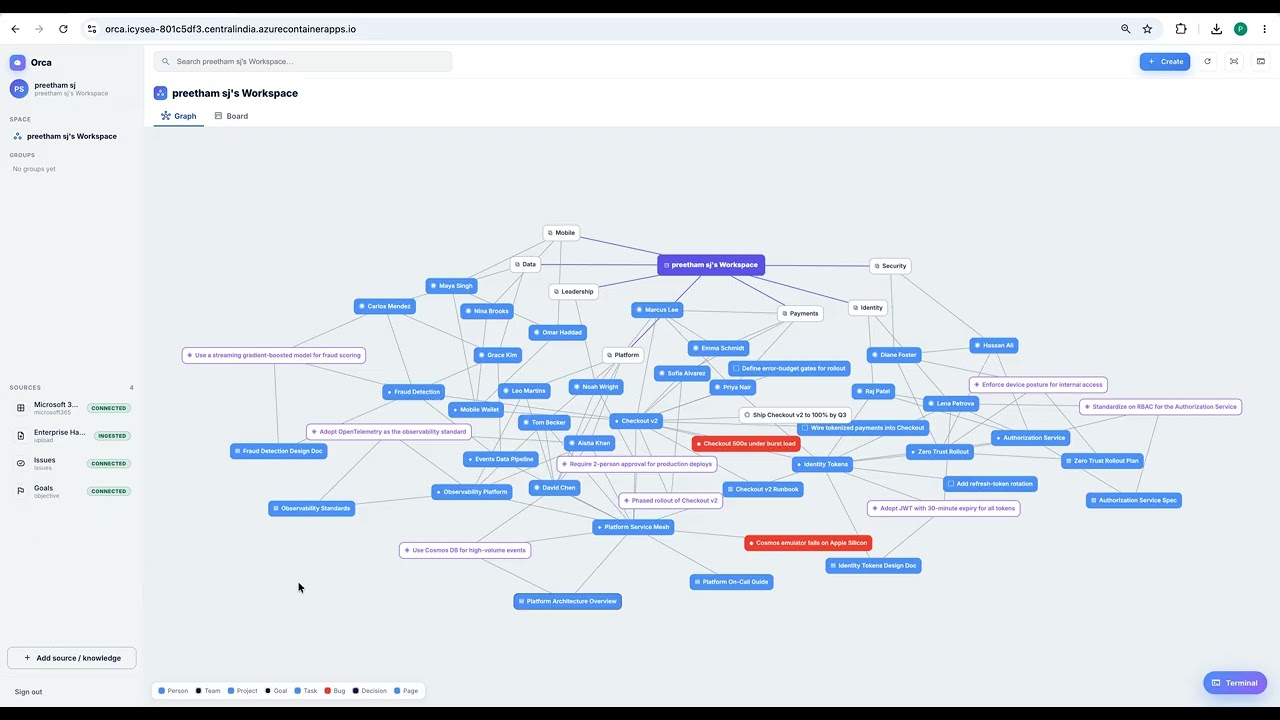
Most enterprise AI bolts a chatbot onto a pile of documents and does single-shot retrieval — so it can’t answer the relational questions that actually run a business: “Who do I need to talk to to unblock the Checkout launch?”
How it works
Orca builds a living Teamwork Graph — people, projects, decisions, dependencies, owners — kept current automatically, and lets agents do multi-hop reasoning over it. “Who unblocks Checkout v2?” becomes a graph traversal, not a guess. A 7-stage agent pipeline runs behind every answer: safety-in → plan → traverse → ground → freshen → synthesize → safety-out, refusing rather than hallucinating when grounding is weak.
Key features
- Multi-hop graph traversal: transitive blockers, shortest path between people, expertise routing
- Grounded answers with citations back to source pages (hybrid retrieval + reranking)
- Responsible-AI layer: prompt-injection screening, PII redaction, refusal on weak grounding
- Four surfaces from one engine: web graph UI, MCP server, CLI, and a Chrome extension
- Runs fully offline in local-demo mode; same code path goes live with cloud credentials
Architecture
Four AI surfaces talk to a FastAPI backend hosting the Orca agent, which sits on the Teamwork Graph engine plus grounded retrieval (Foundry IQ / Azure AI Search) and live Microsoft 365 context via Microsoft Graph.
Stack
Context
Built for the Microsoft Agents League Hackathon 2026 — Enterprise Agents track.